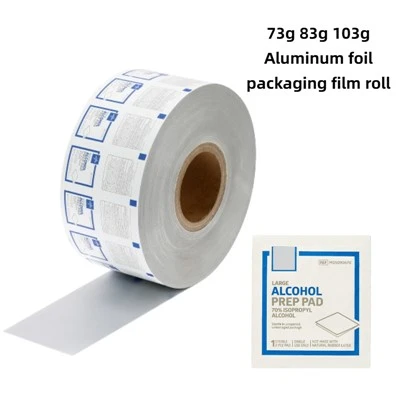
The melting point of aluminum foil is not a fixed value, but is closely related to the purity of its main component-aluminum-the alloy ratio, and the processing technology. Generally, the melting point of pure aluminum is about 660°C, but industrial-grade aluminum foil contains small amounts of other metallic elements (such as copper, magnesium, and manganese) to enhance performance, so its melting point fluctuates slightly, typically between 640°C and 660°C. This temperature range is based on the crystal structure of aluminum: aluminum has a face-centered cubic lattice with strong interatomic bonds, requiring high energy to break its metallic bonds. Therefore, its melting point is significantly higher than common metals such as iron (1538°C) or copper (1083°C), but lower than refractory metals such as tungsten (3410°C).
From an application perspective, the temperature resistance of aluminum foil needs to be comprehensively evaluated in conjunction with its usage environment. For example, in the food packaging industry, aluminum foil is often used for baking or freezing, with a short-term temperature resistance limit of up to 230°C (far below its melting point). At this temperature, the aluminum foil only softens, rather than melts, maintaining its structural integrity. However, in industrial applications, such as high-temperature insulation or heat-reflective materials, aluminum foil needs to withstand sustained temperatures above 400°C. In these cases, high-purity (99.5% or higher) or special alloy aluminum foil must be selected to ensure a stable melting point. Furthermore, the processing technology significantly impacts the melting point: cold-rolled aluminum foil, due to its finer grains, may have a slightly lower melting point than hot-rolled products; while surface coatings (such as polyester films), although not changing the melting point of the aluminum matrix, can improve the overall heat resistance of the material and delay deformation at high temperatures.
Regarding industry standards, the International Electrotechnical Commission (IEC) clearly classifies the temperature resistance of aluminum foil: ordinary grade aluminum foil has a temperature resistance ≤250°C, high-temperature grade up to 400°C, and ultra-high-temperature grade requires a melting point test at 660°C. The domestic standard GB/T 3198-2020, "Aluminum and Aluminum Alloy Foil," also stipulates that differential scanning calorimetry (DSC) must be used to test the melting point of aluminum foil to ensure data accuracy. It is worth noting that aluminum foil exhibits a "softening-flowing" transition zone near its melting point, rather than melting suddenly. Therefore, in practical applications, a safety temperature margin must be allowed to avoid structural failure due to localized overheating.
Compared to similar materials, aluminum foil has a significant advantage in melting point: compared to tin-plated iron (melting point approximately 1538°C, but expensive and prone to corrosion), aluminum foil is lighter and more corrosion-resistant; compared to plastic films (melting points typically below 200°C), aluminum foil's high-temperature resistance makes it the preferred choice for high-temperature environments. However, the high thermal conductivity of aluminum foil (approximately 237 W/m·K) also results in a rapid heating rate, requiring the use of an insulation layer to extend its service life.